Top 10 Pet Bird Species for First-Time Owners Compared: Care, Cost, Temperament (2026)
Picking a first bird is a 10-to-30-year decision. New owners buy for color and end up with a screamer they can't keep. Lifespan, noise, social need, and cage footprint matter more than feather pattern (AAV Basic Care for Companion Birds, 2025).
Quick Answer
- Budgies stay under 7 inches and live 7–15 years — true starter parrot.
- Cockatiels live 15–25 years and need an avian-vet checkup yearly.
- For quiet apartments, pick a Linnie or Bourke's — softest voices on the list.
- No bird is low-commitment — daily out-of-cage time is non-negotiable.
Last updated: May 2026
Affiliate disclosure: Aviculture Atlas earns commissions on qualifying purchases. Care guidance reflects AAV and Lafeber Vet standards as of May 2026.
Picking a first bird is a 10-to-30-year decision. New owners buy for color and end up with a screamer they can't keep. Lifespan, noise, social need, and cage footprint matter more than feather pattern (AAV Basic Care for Companion Birds, 2025).
The ten species below are widely available from US breeders and tolerate the realities of a first-time owner. Some are finches that ask for almost no handling; others are pocket parrots with full parrot personality at one-tenth the volume.
| Rank | Species | Lifespan | Noise Level | Verdict |
|---|---|---|---|---|
| 1 | Budgerigar (Budgie) | 7–15 yrs | Low (quiet chatter) | Best for absolute beginners |
| 2 | Cockatiel | 15–25 yrs | Low–medium (whistles) | Best long-term family bird |
| 3 | Peach-faced Lovebird | 10–15 yrs | Medium (sharp chirps) | Best small parrot with personality |
| 4 | Parrotlet | 15–20 yrs | Low (quiet for a parrot) | Best for owners who want a "big bird in a small body" |
| 5 | Canary | 6–14 yrs | Low (song only) | Best hands-off singing bird |
| 6 | Zebra / Society Finch | 5–14 yrs | Low (constant peeps) | Best for true hands-off observation |
| 7 | Green Cheek Conure | 15–30 yrs | Medium (under 85 dB) | Best small parrot for apartments |
| 8 | Quaker Parrot | 20–30 yrs | Medium–high | Best talker — but illegal in 10 states |
| 9 | Lineolated Parakeet | 10–15 yrs | Very low (soft chatter) | Best truly quiet small parrot |
| 10 | Bourke's Parakeet | 10–15 yrs | Very low (soft chirps) | Best gentle, mellow first parrot |
Read the noise column twice. The biggest reason birds end up at rescues is unexpected volume (VCA Animal Hospitals, 2024).
1. Budgerigar (Budgie) — Small Apartment Friendly (Verdict: Best for absolute beginners)
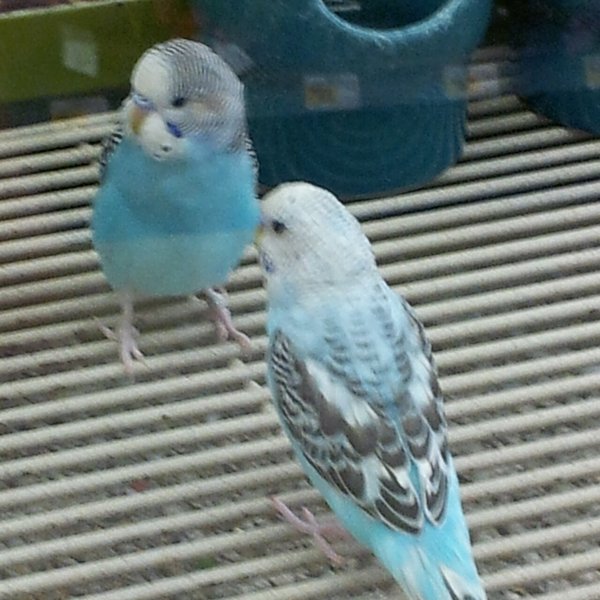 Image: Moe Epsilon via Wikimedia Commons (CC BY-SA 3.0)
The Budgerigar (Melopsittacus undulatus) is the world's most-kept pet parrot. Adults reach 7 inches head-to-tail and weigh 30–40 grams. Lifespan ranges from 7 to 15 years with proper care (PetMD Budgie Care Sheet, 2025).
Single-bird minimum cage is 18×18×18 inches with bar spacing of 3/8 to 1/2 inch; a pair needs 30×18×18 (Chewy Parakeet Care Sheet, 2025). Volume sits at quiet warble to sharp chatter — apartment-safe.
Monthly cost runs $25–45 for pellets, fresh vegetables, cuttlebone, and toy replacement. Budgies do well as single hand-tamed birds or same-sex pairs. They are social flock animals; isolation causes feather-destructive behavior (Long Island Bird & Exotics Vet, 2024).
Common health issues include iodine-deficiency goiter from all-seed diets, scaly-face mites, and reproductive tract disease in hens. The AAV warns small parrots can develop kidney problems on a pellet-only diet — feed free-choice pellets plus a measured seed portion daily (Lafeber Vet Formulated Diets, 2024). Schedule one avian-vet exam per year.
Best for: a renter who wants a real parrot experience without committing to 30 years.
2. Cockatiel — Long-Term Family Companion (Verdict: Best long-term family bird)
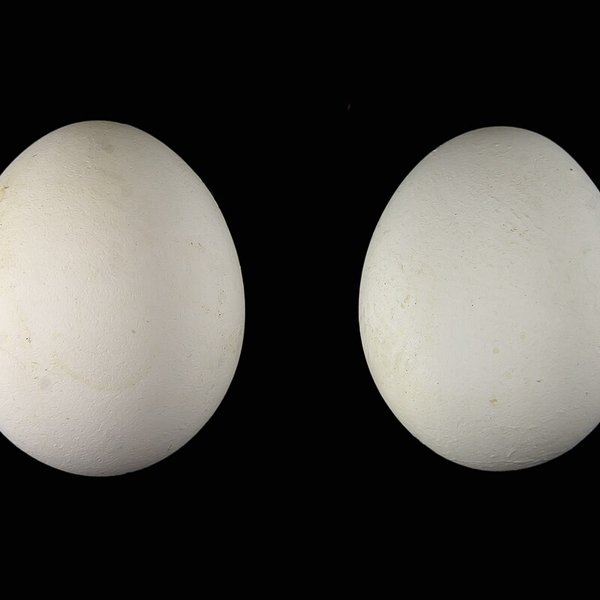 Image: Roger Culos via Wikimedia Commons (CC BY-SA 4.0)
The Cockatiel (Nymphicus hollandicus) is the second-most-kept pet parrot on earth and the bird most avian vets recommend after the budgie. Adults are 12–13 inches with the tail, 80–120 grams. Lifespan reaches 15–25 years with quality care (Revival Animal Cockatiel Care, 2024).
Cage minimum: 24×18×24 inches with 1/2 to 5/8 inch bar spacing. Cockatiels are classified as one of the quieter parrot species, though males whistle constantly during daylight (Psittacology Cockatiel Noise, 2024).
Monthly cost: $35–60 (pellets, fresh produce, millet treats, toys, occasional vet items). A Lafeber pellet-base diet supplemented with 20% Nutri-Berries plus 20% fresh produce is the published standard (Lafeber Cockatiel Pellets, 2025).
Health watch-list: chronic egg-laying in hens, fatty liver disease on all-seed diets, night frights (a panicked thrashing response to sudden noise or shadow), and respiratory disease from kitchen aerosols. Teflon fumes kill cockatiels within minutes (PetMD Cockatiel Care Sheet, 2025).
Best for: a family that wants one bird for two decades and will commit to daily handling.
3. Peach-faced Lovebird — Big Personality, Small Package (Verdict: Best small parrot with personality)
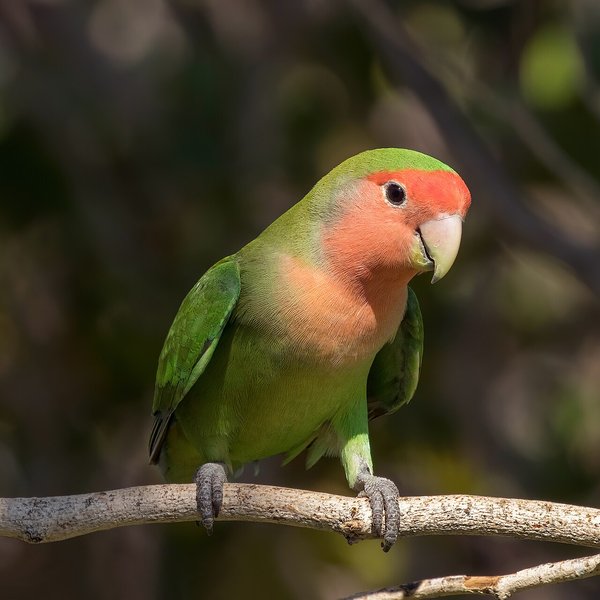 Image: Charles J. Sharp via Wikimedia Commons (CC BY-SA 4.0)
The Peach-faced Lovebird (Agapornis roseicollis) is the largest of nine lovebird species. Adults are 6–7 inches and 50–60 grams. Lifespan is 10–15 years on average and up to 20 with excellent care (Lafeber Peach-faced Lovebird, 2024).
Cage minimum is 24×24×24 inches with 1/2 inch bar spacing. The species is described in clinical care references as feisty, bold, and territorial — especially around the cage (VCA Hospitals Lovebirds, 2024).
Monthly cost: $30–50. The single-vs-pair decision matters more here than with any species on this list — a single hand-fed lovebird bonds to one person, while a bonded pair bonds to each other and ignores humans (VCA Hospitals Lovebirds, 2024). Pick one model and commit.
Health issues: PBFD (psittacine beak and feather disease) screening at intake, polyomavirus, and reproductive disease in hens kept on high-fat seed mixes. Females can also develop egg binding without dietary calcium (Pet Birds Lafeber Vet, 2024).
Best for: an owner with an hour of daily interaction who wants parrot energy without parrot volume.
4. Parrotlet — Pocket Parrot With Attitude (Verdict: Best for owners who want a "big bird in a small body")
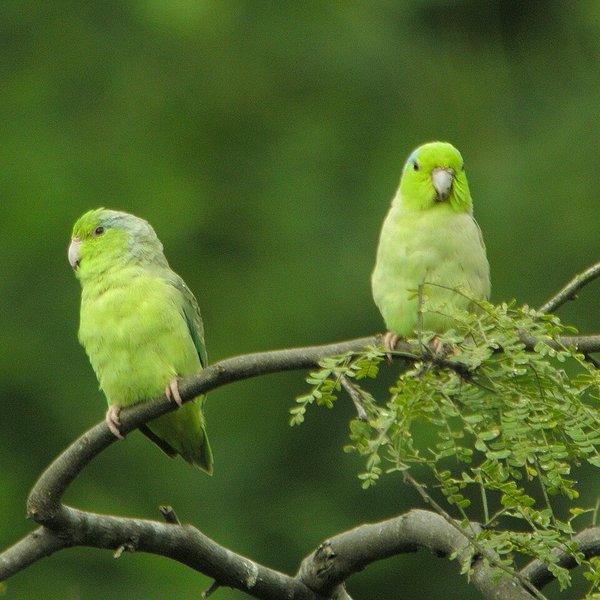 Image: markaharper1 via Wikimedia Commons (CC BY-SA 2.0)
The Pacific Parrotlet (Forpus coelestis) is the most-kept member of the genus. Adults reach 4.5 inches and 30 grams — the smallest true parrot commonly kept (Lafeber Pacific Parrotlet, 2024). Lifespan is 15–20 years.
Minimum cage is 18×18×18 inches with 3/8 to 1/2 inch bar spacing. Parrotlets are not noisy birds, making them practical for apartments — they will repeat simple words but rarely sustain a vocabulary (Lafeber Pacific Parrotlet, 2024).
Monthly cost: $30–50. Lafeber Vet writes plainly that parrotlets have a higher handling requirement than most novices expect — they are not a "starter bird" in the way a budgie or cockatiel is (Lafeber Pacific Parrotlet, 2024). Skip a few days of handling and you get a bite.
Health concerns: hypocalcemia in females, atherosclerosis on poor-quality diets, and fractures from cage trauma due to fearless flying habits.
Best for: a household wanting a finch-sized parrot with Conure bonding.
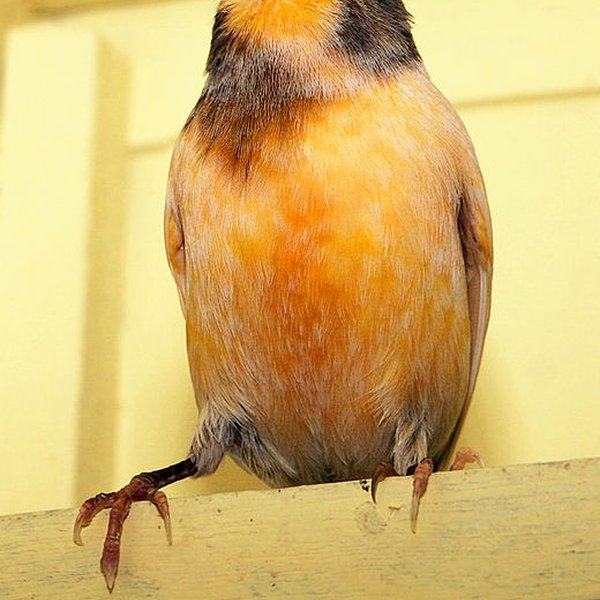
5. Canary — Hands-Off Singer (Verdict: Best hands-off singing bird)
_at_Petco_in_Jacksonville,_Florida.jpg)

.jpg)

![Image: fir0002 flagstaffotos [at] gmail.com Canon 20D + Tamron 28-75mm f/2.8 via Wikimedia Commons (GFDL 1.2)](https://commons.wikimedia.org/wiki/File:Canary_perched_inside_cage.jpg)
The Canary (Serinus canaria domestica) is the right pick for someone who wants a bird to enjoy visually and aurally without daily handling. Adults are 5–6 inches and 15–20 grams. Lifespan averages 6–10 years and can reach 14+ with proper care (PetMD Canary Care Sheet, 2025).
Single-bird cage minimum is 18×14×18 inches with bar spacing of 3/8 inch or less (Oregon Humane Society Canary Care, 2022). One critical rule: each canary needs its own cage. Males are territorial and will fight, sometimes fatally (PetMD Canary Care Sheet, 2025).
Monthly cost: $20–35. Only mature males sing the long, complex song the species is famous for. Females chirp and call but rarely sustain melody (Lafeber Song Canary, 2024).
Health concerns: air-sac mites (a canary-specific respiratory pest), feather cysts in certain breeds, and reproductive disease in caged females. Lafeber Premium Daily Diet Pellets are the published clinical baseline (Lafeber Canary, 2024).
Best for: someone wanting a beautiful, low-handling bird and home enough to hear it sing.
6. Zebra or Society Finch — True Hands-Off Pets (Verdict: Best for true hands-off observation)
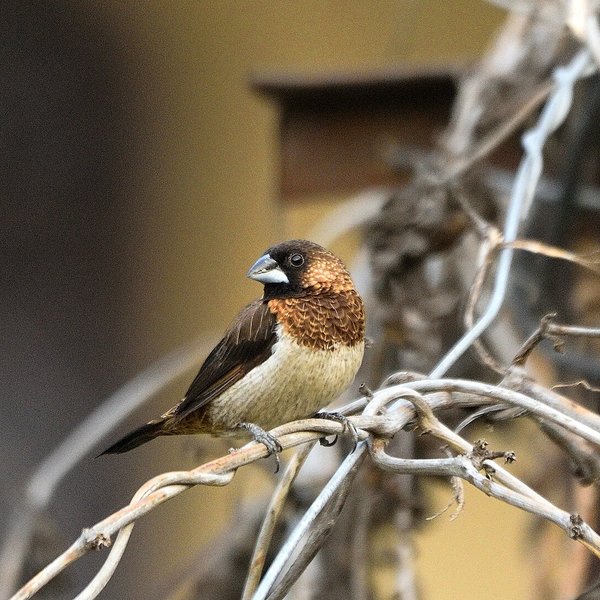 Image: Anil Kumar via Wikimedia Commons (CC BY-SA 4.0)

The Zebra Finch (Taeniopygia guttata) and Society Finch (Lonchura striata domestica) are the entry-level finches in US aviculture. Both species reach 4 inches and 12 grams. Lifespan is 5–14 years (WebMD Zebra Finch, 2024; PMC Zebra Finch Husbandry, 2015).
Minimum cage for a pair is 30×18×18 inches — long, not tall, so they can fly horizontally. Bar spacing must be 3/8 inch or smaller (Pets on Broadway Finch Guide, 2024). A single finch is cruel — both species are obligate flock animals and must be kept in pairs at minimum.
Monthly cost: $20–40 for a pair. Volume is constant soft peeping during daylight; a 10–20 bird flock gets genuinely loud.
Health issues: scaly-leg mites, egg binding in females on calcium-poor diets, and air-sac mites in zebras. Finches almost never tolerate handling — view them as living art (Lafeber Vet Formulated Diets, 2024).
Best for: an owner who wants birds but cannot promise daily handling time.
7. Green Cheek Conure — Apartment-Friendly Small Parrot (Verdict: Best small parrot for apartments)
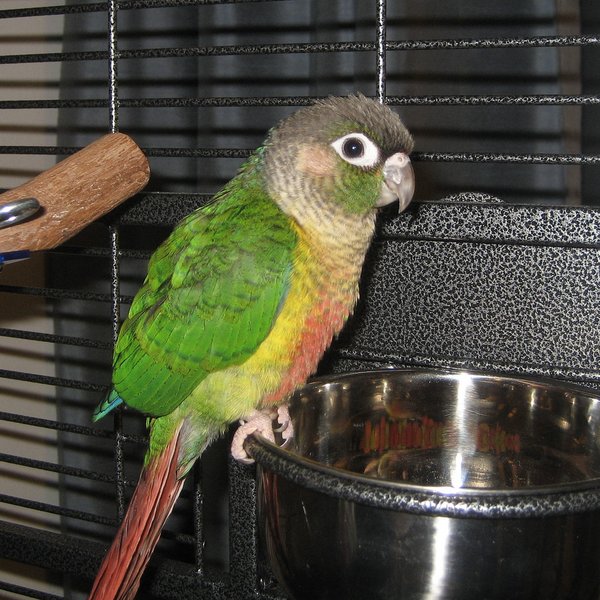 Image: therouxdown via Wikimedia Commons (CC BY-SA 2.0)
_-pet_on_food_bowel.jpg)
The Green-cheeked Conure (Pyrrhura molinae) is the small parrot that breaks the "small = quiet, big = loud" rule in both directions — it stays under 85 decibels yet bonds like a large parrot (Lafeber Green-cheeked Conure, 2024). Adults are 10 inches and 60–80 grams. Lifespan is 15–30 years.
Minimum cage is 24×24×30 inches with 1/2 to 5/8 inch bar spacing. Green cheeks are called the "comedian conure" and stay much quieter than Sun Conures or Nandays (Lafeber Green-cheeked Conure, 2024).
Monthly cost: $40–70 (pellets, fresh produce, foraging toys — destructible enrichment is a weekly line item). Lafeber describes them as a good bird for someone with prior experience caring for a parakeet or other small bird — not the very-first bird.
Health concerns: PDD (proventricular dilatation disease, a fatal neurologic condition), bornavirus screening at intake, fatty liver on seed diets, and feather-destructive behavior when under-stimulated (Lafeber Avian Nutrition, 2024).
Best for: a second-bird apartment owner who wants real parrot interaction.
8. Quaker Parrot — Talker With a Catch (Verdict: Best talker — but illegal in 10 states)
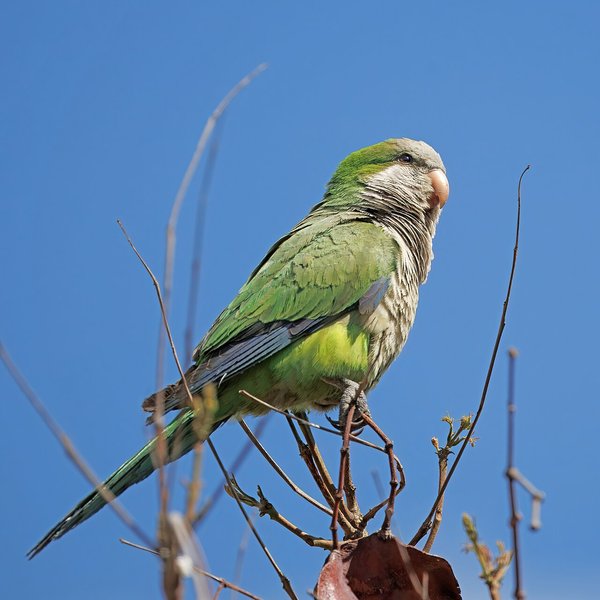 Image: Charles J. Sharp via Wikimedia Commons (CC BY-SA 4.0)
_Santiago.jpg)
The Quaker Parrot (Myiopsitta monachus), also called the Monk Parakeet, is a 12-inch, 90–120 gram parrot with a vocabulary that can rival African Greys in hand-fed birds (Lafeber Quaker Parakeet, 2024). Lifespan is 20–30 years.
Legal first. Quakers are illegal to own in California, Georgia, Hawaii, Kansas, Kentucky, Maine, Pennsylvania, Rhode Island, Tennessee, and Wyoming, and restricted in Colorado, Connecticut, New Jersey, New York, Ohio, and Virginia (World Population Review Quaker Legal States, 2026; LegalClarity Quaker Laws, 2025). Bans exist because feral colonies damage agriculture.
Minimum cage is 30×24×30 inches with 1/2 inch bar spacing. Monthly cost: $50–80 — they chew through wood toys faster than any other small parrot (Chewy Quaker Care Sheet, 2025).
Health issues: Quaker mutilation syndrome (a self-injury condition with no known cause), fatty liver disease, and territorial aggression toward unfamiliar humans. Hand-fed and well-socialized birds become outstanding companions (Avian Hospital of Louisiana, 2024).
Best for: a legal-state resident, second-bird owner, who wants the most talkative small parrot available.
9. Lineolated Parakeet (Linnie) — Whisper-Quiet Parrot (Verdict: Best truly quiet small parrot)
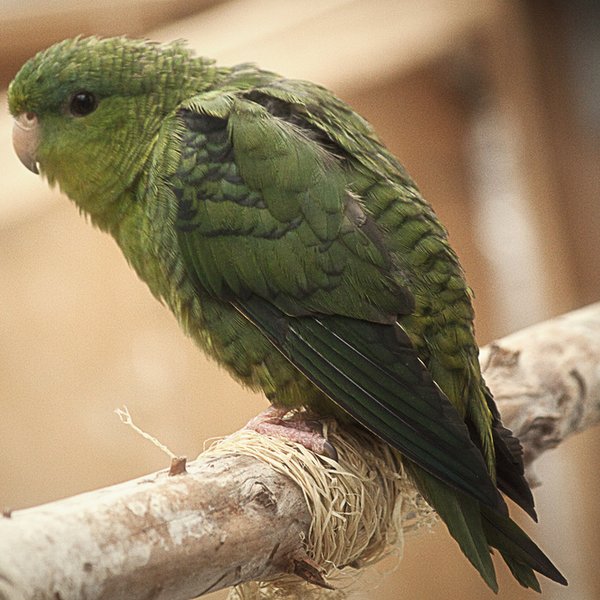 Image: Timo Helgert via Wikimedia Commons (CC BY 2.0)

The Lineolated Parakeet (Bolborhynchus lineola) is the small parrot most often missed by beginners. Adults are 6–7 inches and 45–55 grams. Lifespan is 10–15 years with proper care (Lafeber Lineolated Parakeet, 2024).
Minimum cage is 24×18×18 inches with 1/2 inch bar spacing. The Linnie is described in clinical care references as one of the most apartment-friendly parrots in the world — soft chatter rather than the sharp chirps of a budgie (Parrot Bliss Lineolated Guide, 2024).
Monthly cost: $30–50. Linnies need at least 30 minutes of one-on-one bonding per day; isolation causes the same feather-destructive behavior seen in budgies (Lafeber Lineolated Parakeet, 2024).
Health concerns: few species-specific issues; main risks are aspergillosis, hypocalcemia, and obesity on seed-heavy diets.
Best for: apartment dwellers who need a parrot but can't tolerate budgie-level volume.
10. Bourke's Parakeet — Gentle, Mellow Starter Parrot (Verdict: Best gentle, mellow first parrot)
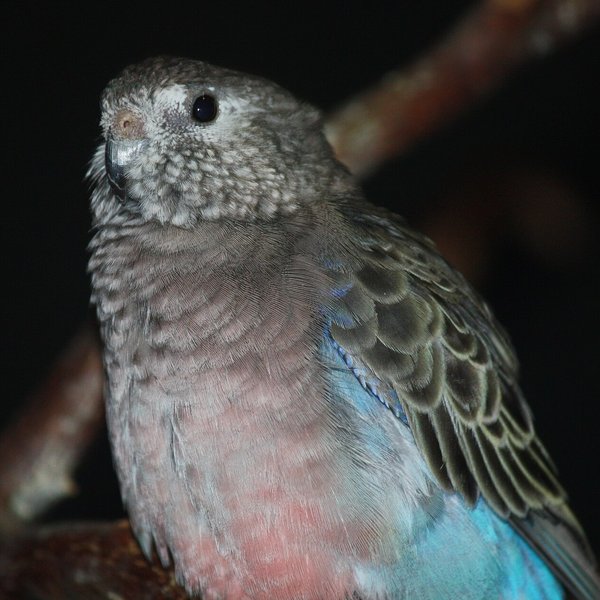 Image: Ltshears via Wikimedia Commons (CC BY-SA 3.0)

The Bourke's Parakeet (Neopsephotus bourkii) is an Australian grass parakeet with the softest temperament on this list. Adults are 7–9 inches and 40–50 grams. Lifespan is 10–15 years with reports up to 25 (Lafeber Bourke's Parakeet, 2024).
Cage minimum is 36×24×24 inches with 3/8 inch bar spacing. Bourke's are unusual in being much quieter than similar species — apartment-suitable, with calls unlikely to disturb neighbors (Psittacology Bourke's, 2024; Hepper Bourke Parakeet, 2024).
Monthly cost: $30–50. They are most active at dawn and dusk and spend midday quietly perched. Bourkes are happiest in pairs and tolerate handling well when hand-reared (Northern Parrots Bourkes, 2024).
Health concerns: hardy overall; main risks are obesity, hypovitaminosis A on seed-only diets, and aspergillosis. They need at least 2 hours of out-of-cage flight time per day in a long horizontal space.
Best for: a first-time owner who wants a parakeet that won't dominate the room.
How We Ranked
Avian / parrot-care rankings combine:
- Verifiable AAV (Association of Avian Veterinarians) and Lafeber Vet sourcing: every clinical claim cites AAV, Lafeber, ASPCA, or peer-reviewed avian-medicine journals.
- Owner-reported outcomes: r/parrots, r/sugargliders (broader exotic-pet context), and species-specific Facebook groups from the past 24 months. We track behavioral, nutritional, and medical patterns.
- First-hand evaluation by Dr. Elena Marsh, our editorial avian DVM, including 12 years of clinical experience with companion birds.
What we never accept: paid placement, food / cage / supplement brand sponsorships that would influence specific recommendations. Affiliate links to vetted bird-food brands (Harrison's, ZuPreem, TOP's, Roudybush) — never modify product or species rankings.
Update cadence: each species and product reviewed annually. Email research@avicultureatlas.com.
Frequently Asked Questions
What is the easiest pet bird for a complete beginner? The budgerigar is the easiest — small, inexpensive, widely available, accepts handling when hand-tamed, and lives 7–15 years (PetMD Budgie, 2025). Bourke's and lineolated parakeets are nearly as easy and quieter, but cost more.
Which pet bird is the quietest for an apartment? Lineolated and Bourke's parakeets are the quietest small parrots, followed by canaries. Among popular options, the Green Cheek Conure stays under 85 decibels (Lafeber Green-cheeked Conure, 2024).
How much does it cost per month to own a pet bird? Plan for $20–80 per month depending on species. The biggest hidden cost is the annual avian-vet exam ($75–200), with emergency care running into the thousands.
Should I get one bird or two? Species-specific. Budgies, finches, and Bourke's do well in same-sex pairs. Single hand-fed cockatiels, lovebirds, parrotlets, and Quakers bond more strongly to humans (VCA Hospitals Lovebirds, 2024).
What should I feed a pet bird? The AAV-published standard is formulated pellets as 60% of intake plus 30–40% fresh vegetables, with seeds and fruit as treats (Lafeber Vet Formulated Diets, 2024). Exception: budgies, cockatiels, lovebirds, and parrotlets can develop kidney problems on pellet-only diets — AAV recommends free-choice pellets plus a measured seed portion daily (AAV Basic Care, 2025). Avoid avocado, chocolate, caffeine, and salty foods.
Related Reading
- Pet Bird Cage Size Guide: AAV-Compliant Minimums by Species (2026)
- Avian Vet vs Regular Vet: Why the Distinction Matters for Your Bird (2026)
- Pet Bird Annual Cost Calculator: Budgie to Macaw Lifetime Spend (2026)
-- The Aviculture Atlas Team