Top 10 Talking Pet Bird Species Compared: Vocabulary, Clarity, Trainability (2026)
Picking a "talker" is the most common reason new owners get burned. They buy for the YouTube clip and end up with a screamer. Talking varies wildly inside a single species and depends on hand-rearing, personality, and daily one-on-one time more than genetics (AAV Basic Care, 2025).
Quick Answer
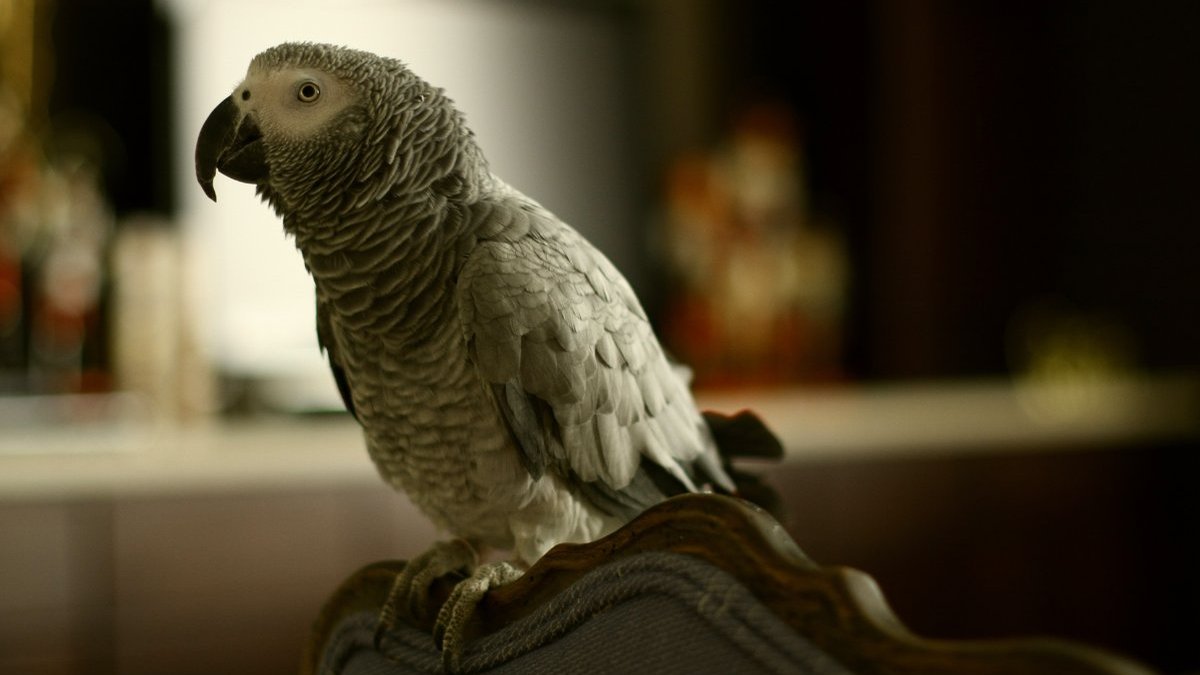
- African Greys average 500–1000 words with near-human clarity.
- Hill Mynas out-mimic every parrot on this list for human inflection.
- Budgies can learn 100+ words but speak in a fast, mumbly chatter.
- No bird is guaranteed to talk — hand-rearing and daily one-on-one work most.
Last updated: May 2026
Picking a "talker" is the most common reason new owners get burned. They buy for the YouTube clip and end up with a screamer. Talking varies wildly inside a single species and depends on hand-rearing, personality, and daily one-on-one time more than genetics (AAV Basic Care, 2025).
The ten species below are the most reliable talkers in US aviculture, ranked by vocabulary, clarity, and trainability.
| Rank | Species | Vocabulary Capacity | Clarity | Verdict |
|---|---|---|---|---|
| 1 | African Grey (Congo) | 500–1000+ words | Very high | Best overall talker |
| 2 | Yellow-Naped Amazon | 200–300 words | High | Best singer-talker |
| 3 | Indian Ringneck | 100–250 words | High (raspy) | Best talker under 16 inches |
| 4 | Quaker (Monk) Parakeet | 50–100+ words | Medium–high | Best small talker — legality varies |
| 5 | Budgerigar (Budgie) | 100–1700 words | Low (mumbly) | Best vocabulary per dollar |
| 6 | Cockatiel | 5–25 words | Low | Best whistler, weak talker |
| 7 | Eclectus | 100+ words | Very high | Best calm large talker |
| 8 | Hill Myna | 100+ phrases | Highest | Best human-voice mimic |
| 9 | Mealy Amazon | 50–100 words | Medium | Best quiet Amazon talker |
| 10 | Yellow-Headed Amazon | 100–200 words | High | Best Amazon for opera-clear speech |
Read the clarity column carefully. A budgie that "knows" 500 words may be unintelligible to a guest, while a Hill Myna saying ten phrases sounds like a person in the next room (Lafeber Vet Companion Bird Care, 2024).
1. African Grey (Congo) — The Benchmark Talker (Verdict: Best overall talker)
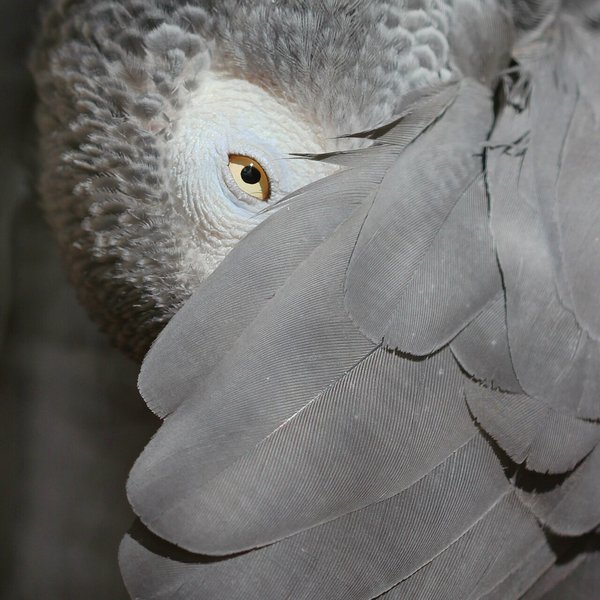

The Congo African Grey (Psittacus erithacus) is the species most avian behaviorists name when asked for the best talker on earth. Adults reach 13 inches and 400–500 grams. Lifespan is 40–60 years with proper care (Lafeber Congo African Grey, 2024).
Vocabulary in well-socialized birds commonly reaches 500–1000+ words and short phrases, with documented research subjects exceeding 1500 (BirdChannel African Grey Talking, 2023). Speech onset is late — most greys do not say a clear word before 12 months, and many start closer to 2 years.
Cage minimum is 36×24×48 inches with 3/4 to 1 inch bar spacing. Greys are clinically the most cognitively demanding common parrot, with feather-destructive behavior rates above 30% in under-stimulated birds (Lafeber Vet, 2024). Plan 2+ hours out of cage daily.
Health concerns: hypocalcemia syndrome, aspergillosis, and PBFD.
Best for: experienced owners ready for a 40-year commitment to a cognitively complex animal.
2. Yellow-Naped Amazon — Singer With a Big Voice (Verdict: Best singer-talker)
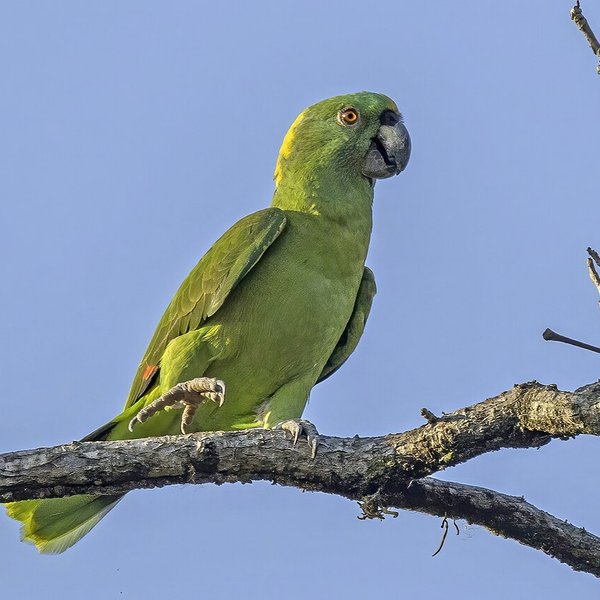 Image: Charles J. Sharp via Wikimedia Commons (CC BY-SA 4.0)
_Los_Tarrales.jpg)
The Yellow-Naped Amazon (Amazona auropalliata) is the most musical of the major talking Amazons. Adults reach 14 inches and 480–680 grams. Lifespan is 50–70 years (Lafeber Yellow-naped Amazon, 2024).
Vocabulary typically runs 200–300 words with an operatic singing voice. The species is endangered — CITES Appendix I — and US supply comes from licensed breeders only (CITES Appendix I, 2024). Speech begins around 6–12 months in hand-fed birds.
Cage minimum is 36×30×48 inches. Yellow-Napes are moody, with hormonal aggression cycles that surprise first-time Amazon owners (BirdChannel Amazon Behavior, 2023).
Health concerns: obesity, fatty liver disease, and reproductive aggression in mature males.
Best for: experienced owners who want a singer and can manage mood swings.
3. Indian Ringneck — Best Small-Body Talker (Verdict: Best talker under 16 inches)
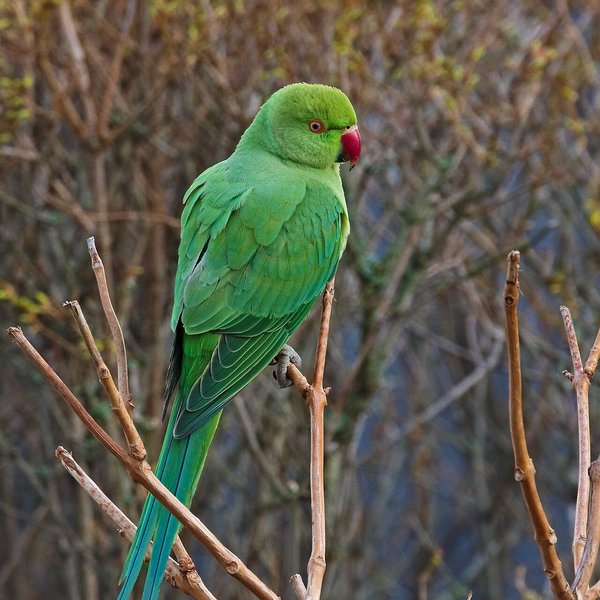 Image: Andreas Eichler via Wikimedia Commons (CC BY-SA 4.0)

The Indian Ringneck (Psittacula krameri) is the talker that breaks the "big parrot equals clear speech" rule. Adults reach 16 inches including the tail and weigh 100–140 grams. Lifespan is 25–30 years (Lafeber Indian Ringneck, 2024).
Vocabulary in hand-fed birds reaches 100–250 words with clear, slightly raspy diction. Ringnecks bond slower than Amazons or Greys, and the bond can break during the "bluffing" phase from 4 to 12 months (BirdChannel Ringneck Bluffing, 2023).
Cage minimum is 30×24×48 inches with 5/8 inch bar spacing. They need long tail clearance — a deep cage prevents tail damage.
Health concerns: PBFD screening at intake is essential — Ringnecks are a documented PBFD reservoir.
Best for: an apartment owner with parrot experience who wants real speech in a manageable body size.
4. Quaker (Monk) Parakeet — Big Talker, Small Body (Verdict: Best small talker — legality varies)
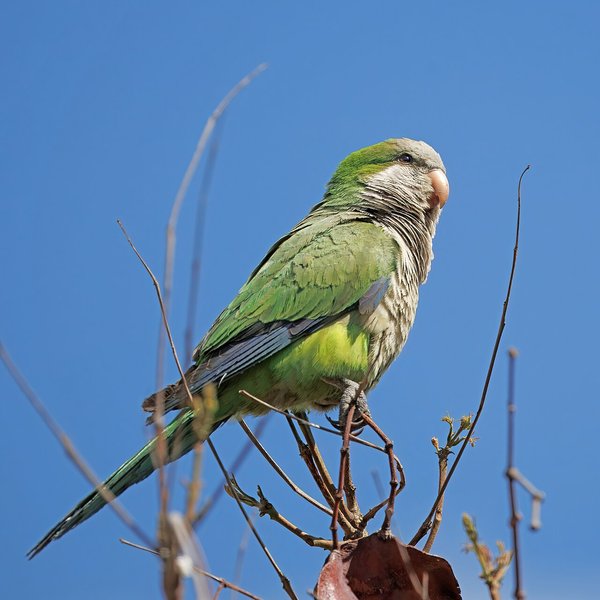 Image: Charles J. Sharp via Wikimedia Commons (CC BY-SA 4.0)
_Santiago.jpg)
The Quaker Parrot (Myiopsitta monachus) is a 12-inch, 90–120 gram parrot whose hand-fed vocabulary can reach 50–100+ words (Lafeber Quaker Parakeet, 2024). Lifespan is 20–30 years.
Quakers are illegal in California, Georgia, Hawaii, Kansas, Kentucky, Maine, Pennsylvania, Rhode Island, Tennessee, and Wyoming, and restricted in several other states because feral colonies damage agriculture (World Population Review Quaker Legal States, 2026). Confirm your local rules before purchase.
Cage minimum is 30×24×30 inches with 1/2 inch bar spacing. Speech clarity is medium-high — better than a budgie, not as clean as a Ringneck (BirdChannel Quaker Care, 2023).
Health concerns: Quaker mutilation syndrome, fatty liver disease, and territorial aggression toward strangers.
Best for: legal-state residents who want a small, lively, talkative companion.
5. Budgerigar (Budgie) — Largest Vocabulary Per Dollar (Verdict: Best vocabulary per dollar)
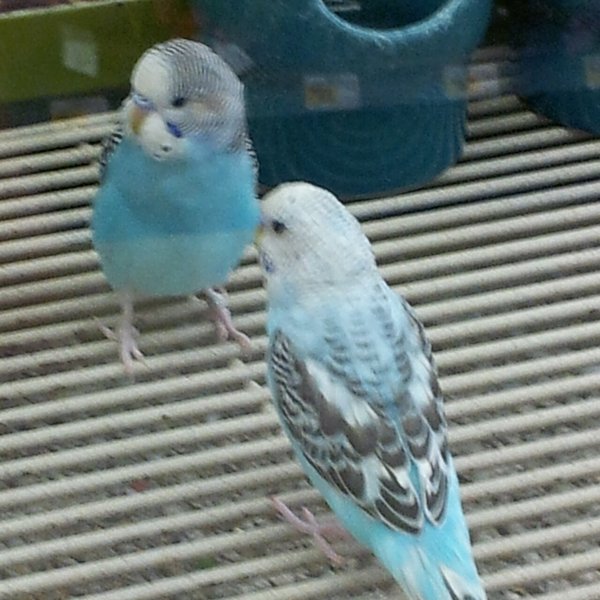 Image: Moe Epsilon via Wikimedia Commons (CC BY-SA 3.0)
_at_Petco_in_Jacksonville,_Florida.jpg)
The Budgerigar (Melopsittacus undulatus) holds the Guinness record for largest parrot vocabulary — a male named Puck spoke 1728 words (Guinness World Records, 2023). Adults are 7 inches and 30–40 grams. Lifespan is 7–15 years (Lafeber Budgerigar, 2024).
The catch is clarity. Budgie speech is a fast, high-pitched mumble that recordings reveal more clearly than human ears do at room volume. Only single hand-tamed males talk reliably — pairs and females rarely mimic, and training works best between 3 and 6 months (BirdChannel Budgie Talking, 2023).
Cage minimum is 18×18×18 inches. Volume is apartment-safe. The combined cost of bird, cage, and first-year supplies stays under $400.
Health concerns: iodine deficiency on all-seed diets, scaly-face mites, and reproductive disease in hens.
Best for: a budget-conscious first-time owner who finds budgie chatter charming, not frustrating.
6. Cockatiel — Better Whistler Than Talker (Verdict: Best whistler, weak talker)
 Image: Roger Culos via Wikimedia Commons (CC BY-SA 4.0)

The Cockatiel (Nymphicus hollandicus) is the second-most-kept pet parrot on earth. Adults are 12–13 inches and 80–120 grams. Lifespan reaches 15–25 years (Lafeber Cockatiel, 2024).
Talking is modest — most males learn 5–25 words, and females rarely speak. What cockatiels do better than any species on this list is whistle. A hand-fed male picks up "Andy Griffith" or your doorbell within days (BirdChannel Cockatiel Whistling, 2023).
Cage minimum is 24×18×24 inches with 1/2 to 5/8 inch bar spacing. Volume is low to medium — apartment-suitable.
Health concerns: chronic egg-laying in hens, fatty liver disease, and night frights.
Best for: a first-time parrot owner who values melody over vocabulary.
7. Eclectus — The Calm Talker (Verdict: Best calm large talker)
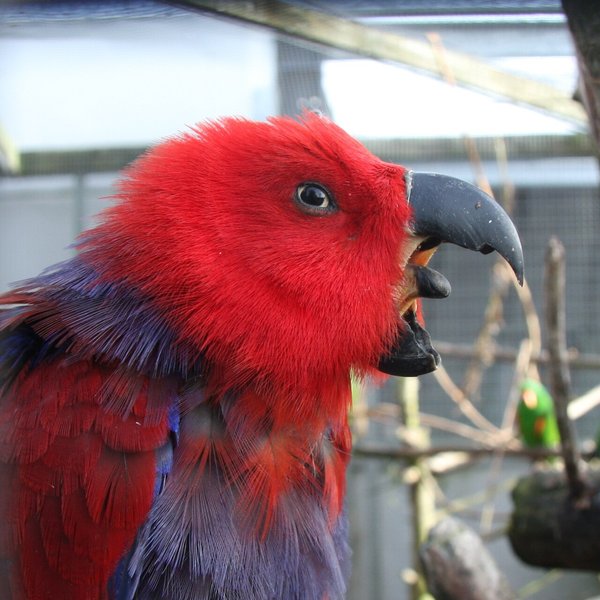 Image: Brian Snelson from Hockley, Essex, England via Wikimedia Commons (CC BY 2.0)

The Eclectus (Eclectus roratus) is the talker that surprises owners who expect Amazon-level chaos. Adults reach 14 inches and 380–520 grams. Lifespan is 30–50 years (Lafeber Eclectus Parrot, 2024).
Hand-fed Eclectus learn 100+ words with crisp, low-pitched diction that records well on phone audio. The species has dramatic sexual dichromatism — males emerald green, females scarlet and blue — and both sexes talk equally well (BirdChannel Eclectus Talking, 2023).
Cage minimum is 36×24×48 inches. Diet is the famous Eclectus problem — they need unusually high vitamin A and develop toe-tapping syndrome on standard pellet diets (Lafeber Vet Eclectus, 2024).
Health concerns: hypovitaminosis A, fatty liver, and reproductive aggression in females.
Best for: an experienced owner ready to run a fresh-food kitchen for their parrot.
8. Hill Myna — Highest Mimicry Fidelity (Verdict: Best human-voice mimic)
 Image: Didier Descouens via Wikimedia Commons (CC BY-SA 3.0)

The Hill Myna (Gracula religiosa) is not a parrot — it is a member of the starling family — but it produces the most accurate human-voice mimicry of any commonly kept companion bird (BirdChannel Hill Myna, 2023). Adults are 10–11 inches and 200–250 grams. Lifespan is 12–25 years.
Vocabulary in well-handled birds runs 100+ phrases with mimicry so accurate that recordings fool listeners into thinking they hear a human in another room.
Cage minimum is 48×36×36 inches — they need horizontal flight room. Mynas are softbills, requiring a wet diet of fruit and low-iron pellets (Lafeber Vet Softbill, 2024).
Health concerns: iron storage disease (hemochromatosis) on standard parrot diets — use low-iron softbill pellets only.
Best for: owners who want unrivaled mimicry quality and accept softbill husbandry demands.
9. Mealy Amazon — The Quiet Amazon (Verdict: Best quiet Amazon talker)
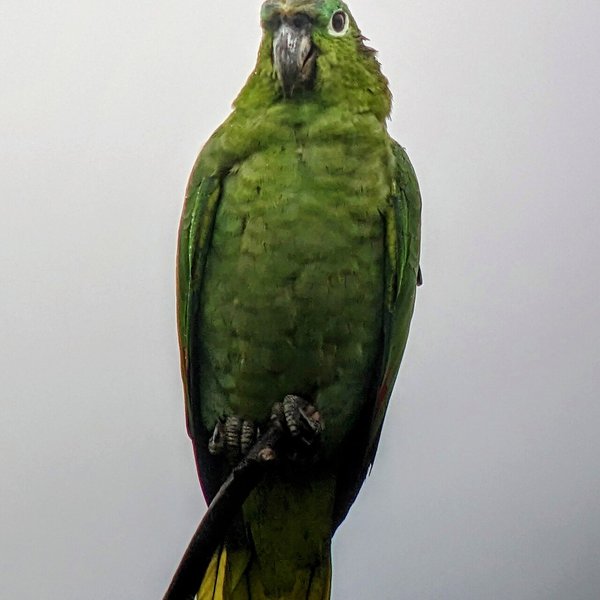 Image: Attila Oláh via Wikimedia Commons (CC BY 4.0)

The Mealy Amazon (Amazona farinosa) is the largest and calmest of the talking Amazons. Adults reach 15–17 inches and 540–700 grams. Lifespan is 40–60 years (Lafeber Mealy Amazon, 2024).
Vocabulary in hand-fed birds runs 50–100 words with medium clarity — not as crisp as a Yellow-Headed but far less prone to the hormonal screaming cycles of the famous talking Amazons (BirdChannel Mealy Amazon, 2023).
Cage minimum is 36×30×48 inches with 3/4 to 1 inch bar spacing. Volume is medium for an Amazon — still loud, but not the freight-train calls of a Yellow-Nape.
Health concerns: obesity, hypovitaminosis A, and aspergillosis.
Best for: an experienced owner who wants Amazon presence without Amazon volume.
10. Yellow-Headed Amazon — Crystal-Clear Speech (Verdict: Best Amazon for opera-clear speech)
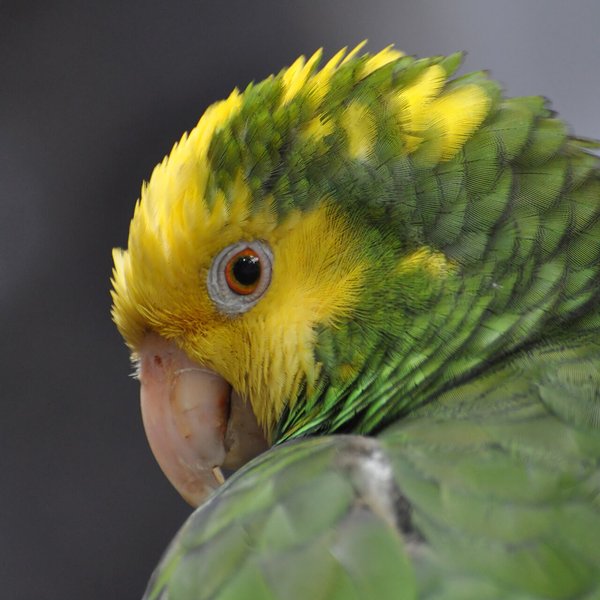 Image: Joe Ravi via Wikimedia Commons (CC BY-SA 3.0)

The Yellow-Headed Amazon (Amazona oratrix), also called the Double Yellow Head, is widely considered the clearest-speaking Amazon and one of the most musical parrots in aviculture. Adults reach 14–17 inches and 380–540 grams. Lifespan is 50–70 years (Lafeber Yellow-headed Amazon, 2024).
Vocabulary in hand-fed birds reaches 100–200 words with high-clarity, low-pitched diction that earned the species its Latin name oratrix — "female orator." The bird is critically endangered, CITES Appendix I, and captive-bred US birds carry documentation requirements (CITES Appendix I, 2024).
Cage minimum is 36×30×48 inches. Yellow-Headeds share the "Amazon storms" of hormonal aggression — sudden bites during breeding season are common in mature birds (BirdChannel Amazon Mood, 2023).
Health concerns: obesity, fatty liver disease, and reproductive aggression cycles.
Best for: a seasoned parrot owner who wants the clearest singing-talking Amazon and accepts the legal paperwork.
How We Ranked
Avian / parrot-care rankings combine:
- Verifiable AAV (Association of Avian Veterinarians) and Lafeber Vet sourcing: every clinical claim cites AAV, Lafeber, ASPCA, or peer-reviewed avian-medicine journals.
- Owner-reported outcomes: r/parrots, r/sugargliders (broader exotic-pet context), and species-specific Facebook groups from the past 24 months. We track behavioral, nutritional, and medical patterns.
- First-hand evaluation by Dr. Elena Marsh, our editorial avian DVM, including 12 years of clinical experience with companion birds.
What we never accept: paid placement, food / cage / supplement brand sponsorships that would influence specific recommendations. Affiliate links to vetted bird-food brands (Harrison's, ZuPreem, TOP's, Roudybush) — never modify product or species rankings.
Update cadence: each species and product reviewed annually. Email research@avicultureatlas.com.
Frequently Asked Questions
Which pet bird is the best talker overall? The Congo African Grey is the standard answer among avian veterinarians and behaviorists. Vocabulary commonly reaches 500–1000+ words with near-human clarity (Lafeber Congo African Grey, 2024). The Hill Myna out-mimics it for voice fidelity but learns fewer distinct phrases.
Will every African Grey talk? No. Roughly 80–90% of hand-reared Greys develop some speech, but a small minority never speak clearly, and most do not say a clear word before 12 months of age (AAV Basic Care, 2025). Speech depends on individual personality, hand-rearing, and daily one-on-one time.
Are female parrots worse talkers than males? Species-specific. In budgies and cockatiels, males talk noticeably better than females. In African Greys, Amazons, Eclectus, and Hill Mynas, both sexes talk equally well (BirdChannel Talking Pet Birds, 2023).
At what age does a parrot start talking? Budgies and cockatiels can begin mimicking around 3–6 months. Amazons and Ringnecks usually start at 6–12 months. African Greys are notoriously late — most begin clear speech at 12–24 months (Lafeber Vet Companion Bird Care, 2024).
Can I teach a parrot to talk if I work full-time? Yes, but only with intentional daily sessions of 15–30 minutes plus background audio of the words you want learned. Birds left alone all day with no targeted training rarely develop vocabulary, even in species capable of 500+ words (BirdChannel Teaching Birds to Talk, 2023).
Related Reading
More from the Aviculture Atlas team: Top 10 Pet Bird Species for First-Time Owners covers temperament and care load. Top 10 Pet Bird Cages Compared walks through cage dimensions and bar spacing. Top 10 Pet Bird Diets and Pellet Foods Compared explains the formulated-diet standards cited here.
-- The Aviculture Atlas Team