Top 10 Pet Bird Pelleted Diets Compared: Harrison's, Roudybush, ZuPreem, Lafeber (2026)
A loose seed mix lacks at least 32 nutrients (WSAVA Avian Malnutrition, 2014). Birds pick the fatty sunflower kernels out of the mix and end up obese with failing livers (Merck Veterinary Manual, 2024).
Quick Answer
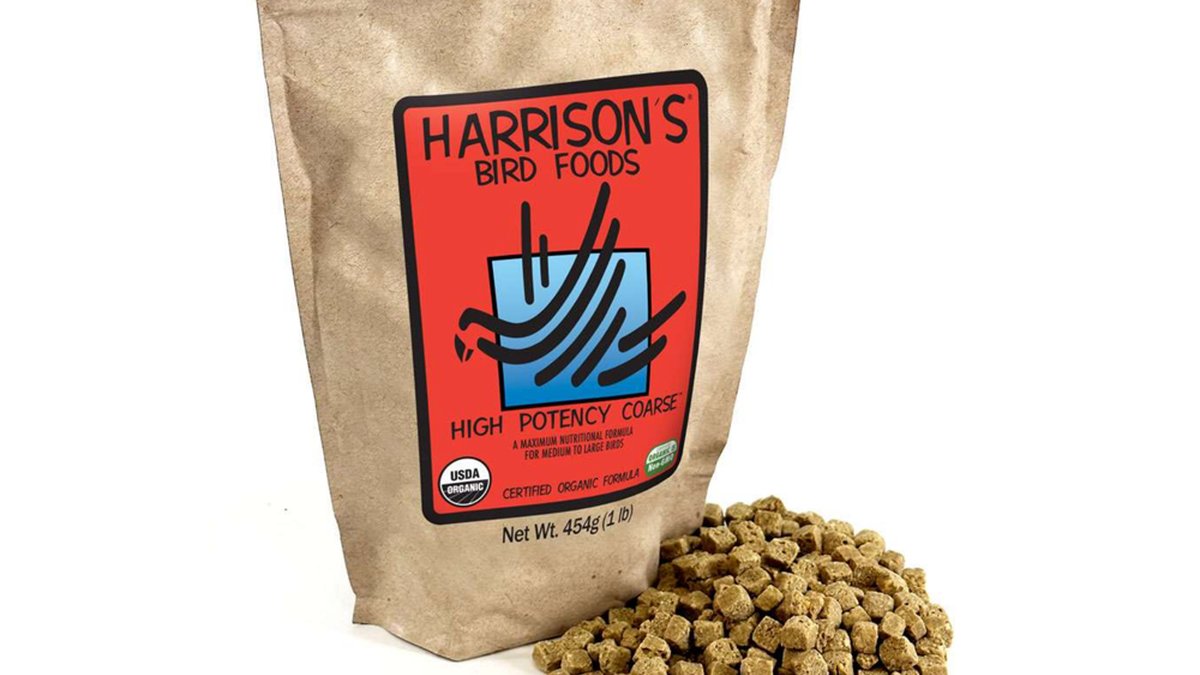
- Harrison's High Potency is the AAV-cited gold standard for seed-to-pellet conversion.
- ZuPreem Natural fits the widest species range — budgie to macaw.
- Pellets should be 60–80% of most parrot diets, not 100%.
- All-seed diets cause fatty liver and shortened lifespan in parrots.
Last updated: May 2026
A loose seed mix lacks at least 32 nutrients (WSAVA Avian Malnutrition, 2014). Birds pick the fatty sunflower kernels out of the mix and end up obese with failing livers (Merck Veterinary Manual, 2024).
A formulated pellet bakes the vitamins, minerals, and amino acids into every bite. The bird can't pick around the calcium.
| Rank | Pellet | Brand | Species Fit | Verdict |
|---|---|---|---|---|
| 1 | High Potency Coarse | Harrison's | Medium–large parrots | Best for converting seed-junkies |
| 2 | Daily Maintenance | Roudybush | Most companion species | Best AAFCO-compliant value |
| 3 | Natural | ZuPreem | Budgie to macaw | Best widest species range |
| 4 | Nutri-Berries | Lafeber | Most parrots | Best pellet-seed hybrid |
| 5 | Adult Lifetime | Harrison's | Healthy adult parrots | Best maintenance follow-on |
| 6 | Organic Pellets | TOPS | Hookbills, sensitive birds | Best soy/corn/peanut-free |
| 7 | Birdy Banquet | Goldenfeast | Larger parrots | Best whole-food blend |
| 8 | Small Bird Diet | Mazuri | Cockatiels, conures | Best zoo-grade small-bird option |
| 9 | Avian Science Super | Volkman | Species-specific (finch to parrot) | Best species-specific formula |
| 10 | Oven Fresh Bites | Caitec | Medium to large parrots | Best no-corn baked option |
LafeberVet recommends pellets make up 60–80% of the diet, with fresh vegetables, limited fruit, and small amounts of seed or nut as enrichment (LafeberVet Avian Nutrition, 2023).
1. Harrison's High Potency Coarse — Organic Premium (Verdict: Best for converting seed-junkies)
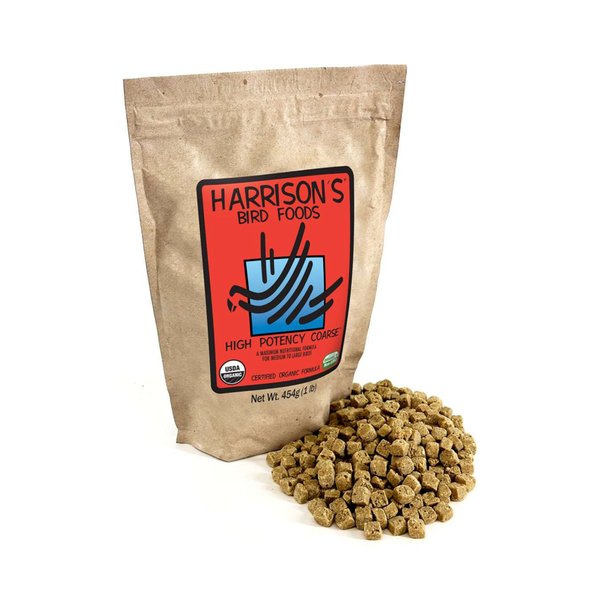
Harrison's High Potency Coarse is the pellet most US avian vets reach for first. The formula targets medium-to-large parrots: Amazons, African greys, eclectus, cockatoos, macaws. It runs as a 6-month conversion diet before stepping down to Adult Lifetime (Harrison's Bird Foods, 2025).
Listed values: 18% protein, 13.5% fat, 6.5% fiber, with 3.8% omega-6 and 0.55% omega-3. The High Potency line packs more fat and vitamins than the maintenance line. That calorie density helps a stressed bird stick with the new food.
Every ingredient is certified organic and non-GMO verified. Base is hull-less barley, sunflower kernels, soybeans, corn, peas, lentils, peanuts, brown rice, oat groats, alfalfa, psyllium, and chia (Harrison's ingredient list, 2025). US retail (May 2026) sits at $19 for 1 lb and $39 for 5 lb on Chewy (Chewy listing, 2026).
2. Roudybush Daily Maintenance — AAFCO-Compliant Workhorse (Verdict: Best AAFCO-compliant value)
Roudybush Daily Maintenance has the same vet following Harrison's does, at half the price. Dr. Tom Roudybush built the line after running pellet conversion studies at UC Davis (Petco product page, 2025).
Listed values runs leaner: 11% protein, 6% fat, 3.5% fiber, 12% moisture (Roudybush listed values, 2025). The lower protein matches what non-breeding adult parrots actually need. Higher protein can stress kidneys long-term.
Ingredient base is ground corn, ground wheat, soybean meal, soybean oil, alfalfa, plus a full vitamin and mineral pack. Not organic, and corn-and-wheat-forward — which puts off some owners. Pellet sizes run nibble, mini, small, medium, and crumble; US retail (May 2026) sits at about $9 for 2.75 lb and $54 for 25 lb at Petco.
3. ZuPreem Natural — Widest Species Range (Verdict: Best widest species range)
ZuPreem Natural is the pellet most US owners encounter first. It's stocked at PetSmart, Petco, and most local pet stores. The Natural line uses no artificial colors — the FruitBlend version has been linked to behavioral issues in sensitive birds (ZuPreem Natural product page, 2025).
Small-bird guaranteed analysis: 14% protein, 4% fat, 5% fiber, 10% moisture. Lower fat than Harrison's — better for maintenance, not ideal for actively molting or breeding birds.
The Natural line covers budgies, parakeets, parrotlets, canaries, finches, cockatiels, lovebirds, conures, African greys, Amazons, eclectus, cockatoos, and macaws — the widest single-formula range on the market. ZuPreem recommends pellets make up at least 60% of the diet. US retail (May 2026): about $14 for 2.25 lb, $42 for 17.5 lb.
4. Lafeber Nutri-Berries — Pellet-Seed Hybrid (Verdict: Best pellet-seed hybrid)
Nutri-Berries are the bridge product. Each "berry" contains hulled whole seeds and 16.5% pellets. The seeds are coated with vitamins, chelated minerals, and amino acids, then bound into a foraging shape that birds shred apart (Lafeber Parrot Nutri-Berries, 2025).
UC Davis vet school ran a study finding Nutri-Berries equal to standard pellets in nutrition (Lafeber Co., 2024). Foraging time roughly doubles versus loose pellets, with real welfare upside.
Listed values: 12.5% crude protein, hulled millet, corn, hulled oats, peanuts, hulled canary grass seed, red millet, safflower, plus the vitamin-mineral coating. Higher fat than maintenance pellets, so feed in measured amounts to non-breeding adults. US retail (May 2026): about $22 for 3.25 lb on Amazon (Amazon Lafeber listing, 2026).
5. Harrison's Adult Lifetime — Maintenance Follow-On (Verdict: Best maintenance follow-on)
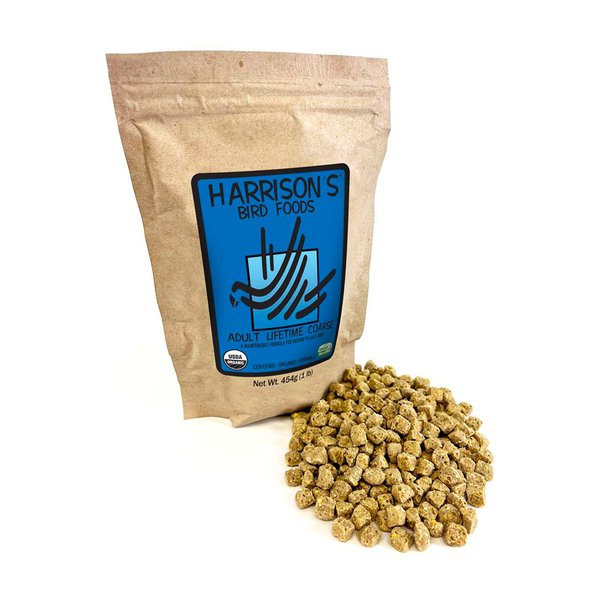
Adult Lifetime is what most Harrison's birds eat after the 6-month High Potency conversion. The formula drops fat and protein to match what a healthy, non-breeding adult parrot really needs (Harrison's Adult Lifetime Coarse, 2025).
Listed values (Coarse): 15% protein, 5.5% fat, 6.5% fiber. The Fine version runs 14% protein, 6% fat, 4.5% fiber for smaller species. Both stay certified organic with the same clean ingredient list as High Potency.
Adult Lifetime suits cockatiels, conures, Amazons, African greys, pionus, cockatoos, and macaws once they've finished conversion. It does not suit breeding birds, young birds, or birds in heavy molt. US retail (May 2026) sits at $19 for 1 lb and $42 for 5 lb (Northern Parrots Adult Lifetime listing, 2026).
6. TOPS Birds Pellets — Soy, Corn, Peanut-Free (Verdict: Best soy/corn/peanut-free)
TOPS is the pellet for owners worried about soy, corn, peanuts, or added vitamins. Cold-pressed instead of heat-extruded, which keeps more of the raw nutrient profile. USDA Organic Certified and non-GMO (TOPS Parrot Pellets, 2025).
Standard pellet guaranteed analysis: 12% protein, 3.5% fat, 10.5% fiber. The Mini version runs higher: 13.6% protein, 5% fat, 8% fiber for smaller species (TOPS Mini Pellets, 2025). High fiber is unusual in this market — closer to a wild whole-food profile.
Ingredient list reads like a salad: organic alfalfa, hulled millet, barley, brown rice, hulled sunflower, sesame, quinoa, pumpkin, buckwheat, dandelion leaf, carrot, spinach, dulse, kelp, rose hips, orange peel, lemon peel, rosemary, cayenne, nettle (TOPS ingredient highlights, 2025). US retail (May 2026): about $22 for 4 lb, $45 for 10 lb on Chewy.
7. Goldenfeast Birdy Banquet — Whole-Food Blend (Verdict: Best whole-food blend)
Goldenfeast sits between pellet and trail mix. Each blend layers dried fruits, veggies, nuts, legumes, seeds, grains, and a pellet portion, with no fake colors, fake flavors, or synthetic vitamins (Goldenfeast Premium Bird Food, 2025). Probiotics are added for gut support.
Birdy Banquet is the entry blend in the line, with regional formulas (Amazon, Madagascar, Australian, Central American, Indonesian) targeting different species' wild diet patterns (Healthy Bird Goldenfeast ingredient listing, 2024). Not AAFCO-formulated, which is the trade-off.
The format works best as 30–50% of the diet alongside a true formulated pellet. Used alone, a bird can still pick around components. US retail (May 2026): about $24 for 3 lb, $90 for 25 lb depending on blend.
8. Mazuri Small Bird Diet — Zoo-Grade Small-Bird Pellet (Verdict: Best zoo-grade small-bird option)
Mazuri is the Purina-owned exotic animal feed brand used in zoos and breeding programs. Small Bird Diet targets cockatiels, conures, lovebirds, Quakers, and similar small parrots (Mazuri Small Bird Diet, 2025).
Listed values: 14.5% protein, 5% fat, 5% fiber, 12% moisture, vitamin E at 150 IU/lb, omega-3 at 0.40% (Mazuri product sheet PDF, 2025). Ground corn, wheat middlings, dehulled soybean meal, ground flaxseed, dicalcium phosphate, soybean oil — standard extruded pellet base with added flax for omega-3.
No artificial colors or flavors, with live beneficial microorganisms added. Mazuri's volume scale keeps the cost low for multi-bird households and breeders at about $24 for 2.5 lb and $58 for 25 lb (May 2026).
9. Volkman Avian Science Super — Species-Specific Formulas (Verdict: Best species-specific formula)
Volkman runs separate formulas for parakeet, canary, finch, parrotlet, parrot, and eclectus. Each is built around that species' wild seed profile, then layered with vitamins and minerals. The Eclectus version notably avoids fortified synthetic vitamin A — eclectus parrots are prone to toe-tapping linked to over-supplementation (Volkman Avian Science Super Parakeet, 2025).
Protein varies by species formula: 13.5% for parakeet and parrotlet, 15.25% for finch, 17% for canary (Volkman Canary formula, 2025). Higher canary protein matches the species' actual breeding-season demand.
This is technically a seed-pellet mix rather than a pure pellet — each formula contains species-appropriate seeds, pellet pieces, dried fruit, vegetable, and oyster shell. US retail (May 2026): about $18 for 4 lb, $80 for 20 lb.
10. Caitec Oven Fresh Bites — No-Corn Baked Diet (Verdict: Best no-corn baked option)
Oven Fresh Bites breaks from the corn-and-wheat extruded pellet template. The primary energy sources are oatmeal, oat flour, white millet flour, and quinoa flour, with over 30 ingredients total (Caitec Oven Fresh Bites ingredients, 2025). Baked, not extruded — preserves more nutrients than high-heat extrusion.
Listed values: 15% minimum crude protein (Caitec Oven Fresh Bites overview, 2025). Ingredient list includes sunflower meal, dried egg product, wheat germ meal, lentils, barley flour, alfalfa meal, marigold meal, carrots, peas, blueberries, apples, plus the full vitamin and mineral pack.
The Bites format is closer to a small baked cookie than a hard pellet — softer texture appeals to birds that have rejected harder extruded pellets. US retail (May 2026): about $20 for 28 oz, $28 for 42 oz at Petco.
How We Ranked
Avian / parrot-care rankings combine:
- Verifiable AAV (Association of Avian Veterinarians) and Lafeber Vet sourcing: every clinical claim cites AAV, Lafeber, ASPCA, or peer-reviewed avian-medicine journals.
- Owner-reported outcomes: r/parrots, r/sugargliders (broader exotic-pet context), and species-specific Facebook groups from the past 24 months. We track behavioral, nutritional, and medical patterns.
- First-hand evaluation by Dr. Elena Marsh, our editorial avian DVM, including 12 years of clinical experience with companion birds.
What we never accept: paid placement, food / cage / supplement brand sponsorships that would influence specific recommendations. Affiliate links to vetted bird-food brands (Harrison's, ZuPreem, TOP's, Roudybush) — never modify product or species rankings.
Update cadence: each species and product reviewed annually. Email research@avicultureatlas.com.
Frequently Asked Questions
How do I switch my bird from seeds to pellets?
Get a vet exam first and weigh your bird daily during conversion. The Lafeber-recommended method is timed seed reduction: offer seed for only 30 minutes three times a day, with pellets available constantly between meals. If your bird loses more than 10% of starting body weight, stop and call your avian vet (Lafeber pellet conversion guide, 2025).
What percent of the diet should be pellets?
Most companion parrots do best on 60–80% pellets with the remaining 20–40% as fresh vegetables, small amounts of fruit, and limited seed or nut as enrichment (LafeberVet Avian Nutrition, 2023). Lories, eclectus, and some softbills have different needs.
Do pellets have added vitamins, or do I need supplements?
Formulated pellets like Harrison's, Roudybush, ZuPreem, Mazuri, and Caitec contain a complete vitamin and mineral pack. Adding a separate multivitamin on top can cause hypervitaminosis, especially with vitamin A and vitamin D3 (Merck Veterinary Manual, 2024).
How should I store pellets to keep them fresh?
Buy bag sizes you can finish in 60–90 days. Store in an airtight container in a cool, dark cupboard — heat and light degrade vitamin A and vitamin E fastest. Cold-pressed pellets like TOPS have shorter shelf life than extruded.
What are signs my bird isn't tolerating a new pellet?
Watch the droppings, weight, and feather quality. Sustained weight loss greater than 10% from baseline is a stop-everything sign (Lafeber conversion case studies, 2024). Itchy skin, feather plucking, or behavioral changes can point to a specific ingredient sensitivity — usually corn, soy, or peanut.
Related Reading: Pair this guide with our Top 10 Pet Bird Species for First-Time Owners Compared for matching the right pellet to the right starter species. For deeper coverage of the diet-driven liver damage pellets prevent, see Fatty Liver Disease in Parrots. For a head-to-head on the three top vet-recommended brands, our Harrison's vs Roudybush vs Zupreem comparison breaks down the trade-offs.
This article is for educational purposes and does not replace veterinary advice. Companion bird nutrition decisions should be made with a board-certified avian veterinarian (ABVP-Avian) who knows your bird's age, species, weight, and health history. All-seed diets are linked to shortened lifespan in parrots — switching to a formulated pellet is one of the highest-impact welfare changes an owner can make.
-- The Aviculture Atlas Team